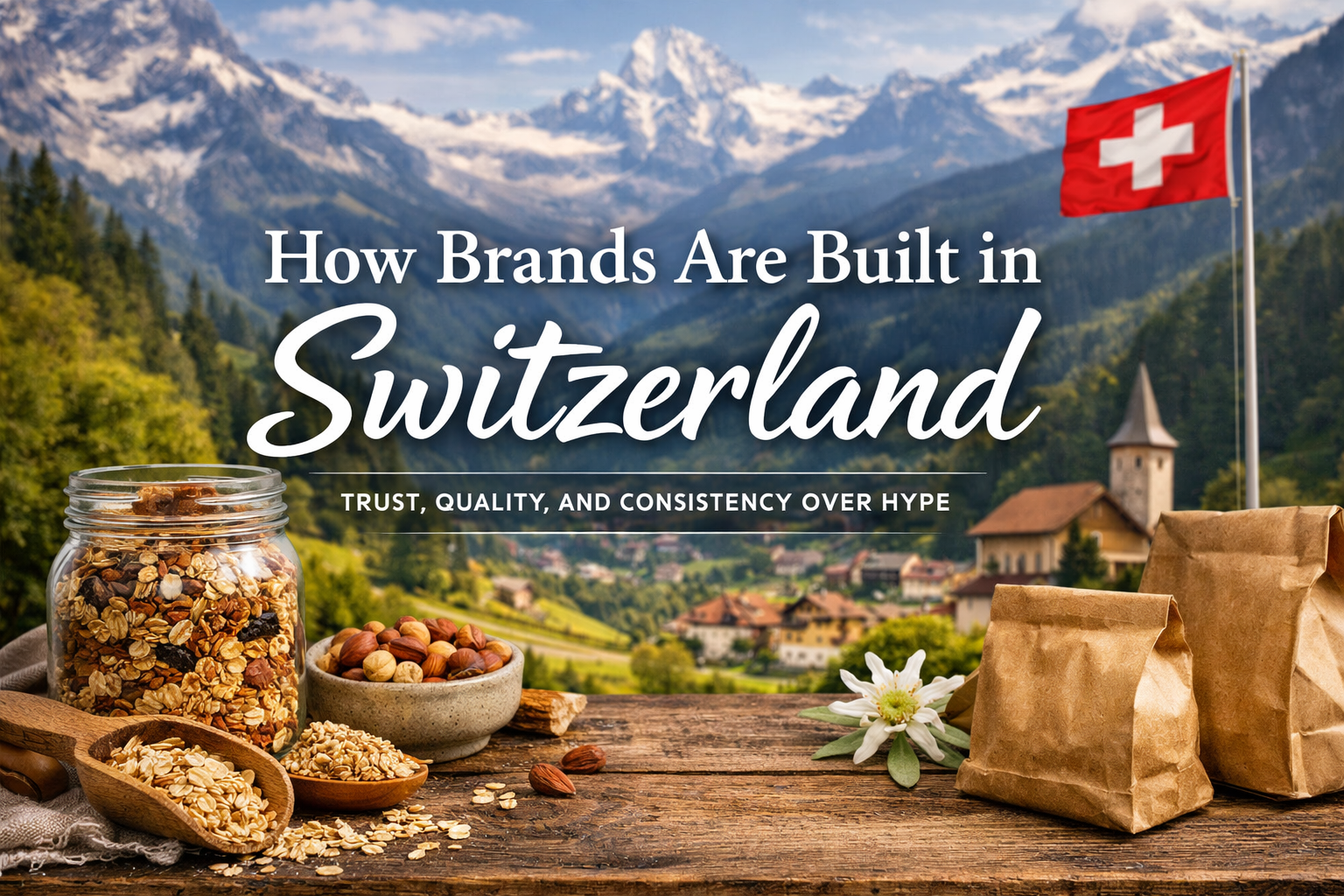
The Tiny Factory a brand that was built on strong values.
There is something quietly compelling about certain brands in Switzerland. They don’t announce themselves loudly. They don’t compete aggressively for attention. In fact, you could walk past them, scroll past them, and almost miss them entirely. And yet, they endure.

One such example is The Tiny Factory, a small granola brand built around organic ingredients, local sourcing, and sustainable production. At first glance, there is nothing particularly disruptive about it. The concept is simple—almost intentionally so. But the longer you sit with it, the more it begins to reveal. Because what stands out is not innovation in the conventional sense. It is coherence.
Everything about the brand feels aligned. The ingredients are organic, not as a label, but as a standard. The sourcing is local, not as a marketing angle, but as a given. Production follows sustainable principles, not as a campaign, but as a way of operating. Even the structure of the team—composed entirely of women, many working part-time—reflects a broader sensitivity to how work fits into life, particularly for those balancing professional and family responsibilities.
Nothing feels added. Nothing feels exaggerated. And in that restraint, something becomes clear: this is not a brand trying to position itself. It is a brand that simply reflects the context in which it exists. To understand why this matters, one has to look beyond the brand itself and toward the environment that sustains it. In Switzerland, consumption is rarely passive. People do not simply buy products—they evaluate them. There is an attentiveness to origin, to process, to intention. Labels are read. Ingredients are questioned. Claims are measured against reality.
Food, in particular, occupies a central role in this dynamic. It is not treated lightly, nor is it easily abstracted into trends. Health is not something to be marketed toward; it is something already embedded in everyday decision-making. Sustainability, similarly, is not an accessory to the product—it is part of its expectation. This creates a consumer who is, in many ways, difficult to persuade but highly capable of recognizing consistency. And it is precisely within this environment that brands like The Tiny Factory begin to make sense.
Because if the consumer is informed, then visibility alone is not enough. In many markets, brands are built through exposure. They compete for attention, investing heavily in communication designed to interrupt, persuade, and convert. The logic is clear: the more visible a brand becomes, the more likely it is to succeed. In Switzerland, that logic appears to shift.
Brands do not disappear from the landscape—but they do not dominate it either. Even in central cities like Zurich or Lucerne, the absence of visual noise is noticeable. There are fewer billboards, fewer aggressive campaigns, fewer attempts to impose presence. Instead, what seems to matter is something less immediate but far more durable: reputation.
Reputation, here, is not constructed overnight. It is built slowly, through repetition, through consistency, through the accumulation of small, credible actions over time. It is reinforced not by what a brand claims, but by what it repeatedly demonstrates. And once established, it carries weight.
Nowhere is this more evident than in the food industry. Because food is, perhaps more than any other category, inseparable from questions of trust. It enters the body. It becomes part of daily life. And as such, it is evaluated with a level of scrutiny that goes beyond surface-level appeal.
For global players such as Nestlé or Mondelez International, operating within this context requires more than scale or recognition. It requires adaptation—not only to regulatory standards, but to cultural expectations that prioritize transparency, quality, and accountability. The implication is significant.
Because in the Swiss market where consumers are attentive and values-driven, smaller brands are not necessarily at a disadvantage. On the contrary, they can become highly competitive—not by outspending larger players, but by aligning more precisely with what people are looking for.
This is where The Tiny Factory becomes particularly instructive. It does not attempt to accelerate growth through visibility. It does not rely on the mechanics of constant exposure. Instead, it appears to follow a different trajectory—one that begins not with communication, but with conviction.
Values are defined early. Operations are built around them. Consistency is maintained. And over time, trust emerges—not as a goal to be achieved, but as a consequence of alignment.
It is, by most contemporary standards, a slower way of building a brand. But it is also, perhaps, a more resilient one. In many parts of the world, success is measured by how quickly a brand can be seen, recognized, and scaled. In Switzerland, the measure feels different. It is not simply about being known. It is about being believed. And that distinction changes everything. Because when belief becomes the foundation, marketing no longer functions as a tool to convince. It becomes a reflection of something that already exists. A way of making visible what has been consistently built, long before any campaign begins.
Perhaps that is why brands like this feel so quietly powerful. They do not demand attention. They earn it. And once they do, they no longer need to compete for it in the same way. They simply continue—steadily, consistently—within a system that values not what is said the loudest, but what proves itself over time.
What do you think?
Remember to stay curious.
by Grazia Rabasa






Leave a Reply