One of the unexpected things about moving to Switzerland is how much you learn from the small details. Not the mountains. Not the trains. Not even the famous Swiss punctuality. But the everyday things that slowly become part of your routine.
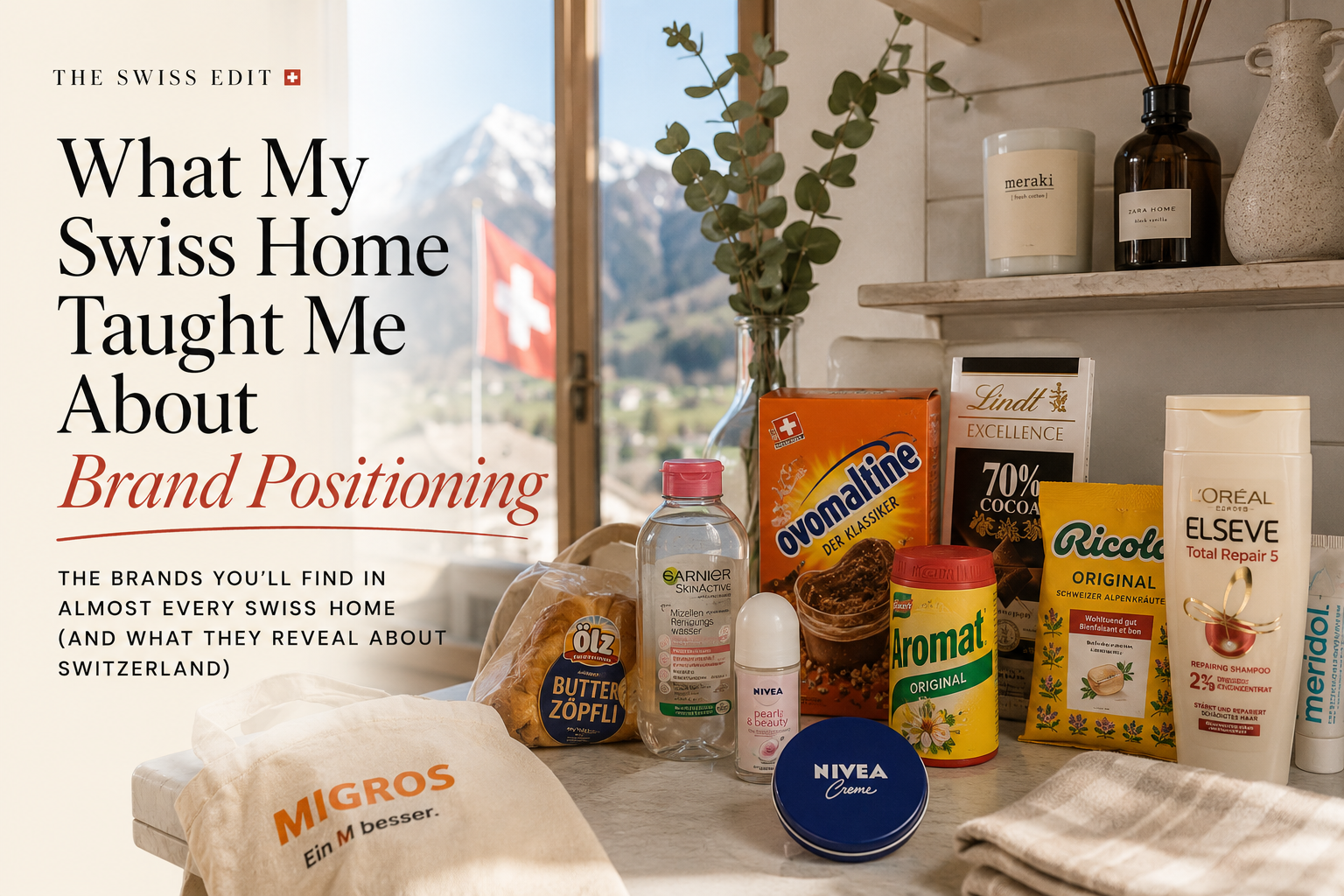
The other day, I was at home putting away groceries when I noticed something interesting. My cupboards, fridge, and bathroom shelves were filled with brands I barely knew a year ago. Lindt. Ricola. Ovomaltine. Aromat. Migros products. And somehow, without even realizing it, they had become part of my daily life. That got me thinking.
What do the brands inside a home actually say about a country?
That question stayed with me for a while. As someone who studies marketing, I’ve always been fascinated by brands. But living in Switzerland made me look at them differently. Instead of noticing them in advertisements, I started noticing them in everyday life. So I decided to test a simple idea.
What would happen if I looked around my own home and paid attention to the products we use every day? Not just my products, but also those of my three Swiss housemates.
The result was surprisingly revealing. Some brands appeared over and over again. Others were products I had never heard of before moving here. Yet somehow they had all earned a place in our cupboards, fridges, bathrooms, and daily routines.
That’s what inspired the video below.
>> I put it to the test in my own shared home here in Switzerland. Take a look and see how many of these brands you recognize. <<
REFLECTIONS FROM ALL THE BRANDS I FOUND AT HOME
Making this video made me think about something we often discuss in marketing classes: positioning. Positioning is the place a brand occupies in the consumer’s mind. The strongest brands are not necessarily the brands people like the most. They are the brands people think of first. And that’s exactly what I realized had happened to me.
When I first arrived in Switzerland, I didn’t have any relationship with most of the brands I found in supermarkets. I had my own mental shortlist of products and brands that I trusted from Peru. Those were my defaults. Those were the brands that occupied space in my mind. Then something interesting happened.
Through repeated exposure, recommendations from Swiss friends, supermarket visits, and daily routines, a completely new set of brands slowly started entering my life. Not overnight. Not through a single advertisement. But through constant presence.
The more I encountered certain brands, the more familiar they became. The more familiar they became, the more I trusted them. And the more I trusted them, the more likely I was to choose them again. This is one of the most powerful mechanisms in marketing.
Consumers often believe they make purely rational decisions, but familiarity plays a much bigger role than we think. Over time, repeated exposure reduces uncertainty. A brand becomes recognizable, then reliable, and eventually it becomes the default option.
That is positioning at work. Looking around my apartment today, I can see evidence of that process everywhere. Many of the products that now feel completely normal to me were brands I had never heard of a year ago. What’s even more fascinating is that some brands weren’t actually new at all.
One of the biggest surprises was discovering that Elseve, a product I kept seeing in Switzerland, was actually Elvive—the same L’Oréal shampoo line I had known for years in Peru. The product was familiar.The company was familiar. Only the name was different.
That realization made me think about how global brands adapt themselves to local markets while maintaining the trust they have built over decades. But beyond individual brands, I realized something else. Moving to Switzerland required me to rewire my own shopping habits. The criteria I used to evaluate products started changing.
In Switzerland, consumers seem to place enormous value on reliability, consistency, quality, and trust. These values appear repeatedly across industries, whether we’re talking about transportation, banking, insurance, food products, or household brands. Over time, I found myself adopting those same criteria. I became less interested in novelty and more interested in products that consistently delivered what they promised. And perhaps that is why so many Swiss brands remain successful for generations.
Their greatest strength is not necessarily innovation or visibility. It is trust. Trust built over years. Trust reinforced through every interaction. Trust strong enough that consumers continue choosing the same brands without even questioning the decision. Looking around my house today, I don’t just see products. I see the outcome of thousands of positioning decisions made by companies over decades. And perhaps that’s what fascinates me most.
The strongest brands don’t simply sell products. They shape habits. And eventually, those habits become part of who we are. Trust me the longer I am in Switzerland the more I eat like the Swiss and use the same products, not for novelty, but because I believe in their system of trust in the brands they often use.
By Grazia Rabasa




Leave a Reply